
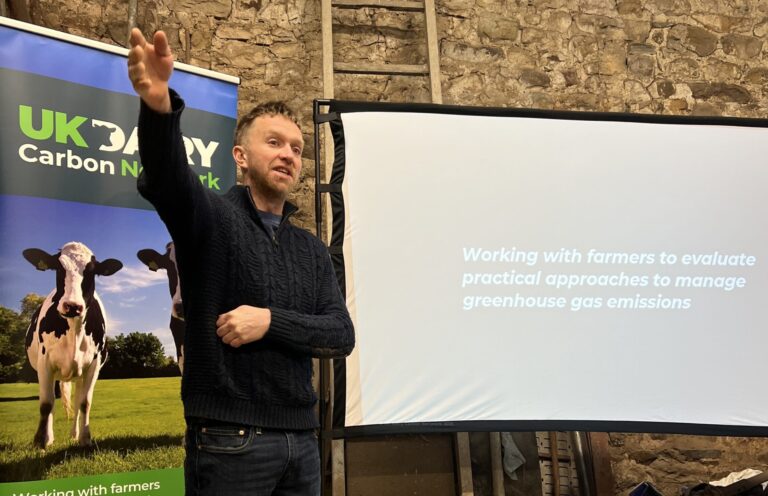
Lancashire’s Mason House Farm recently hosted farmers for a UK Dairy Carbon Network (UK-DCN) event, sharing how investment, innovation and collaboration are helping drive efficiency and support the farm’s plans for future expansion.
For the past 18 years, Ben Hartley and his parents, John and Sarah, have managed a predominantly Holstein herd through a robotic milking system, making John an early adopter of a technology that has since become widely used across the UK dairy sector. Since installing their initial two robots, the system has expanded to four units, while cow numbers have grown from 140 to 255. The all-year-round calving herd now produces over 10,000 litres per cow annually, at 3.5% protein and 4.3% butterfat.
The Hartleys rear all their own replacements and manage around 145 head of youngstock. Grassland is managed through a dual-approach system: a multi-cut regime delivering four cuts per year, and a grazing platform supporting their heifers and 400 hoggets (one to two-year-old sheep).
Ambitions for growth
Despite farming entirely on tenanted land – 166 hectares under a mix of Agricultural Holdings Act (AHA) and Farm Business Tenancy (FBT) agreements – the family continues to invest confidently in the business. A recently awarded grant will fund the installation of four additional milking robots, which will allow the farm to eventually double the herd size.
“We have been very piecemeal with how we’ve expanded in the past,” Ben explained. “It’s a bigger job than we have ever done in one go, but we are a Tesco Arla farm and have had a favourable milk contract the last few years, so we are in a positive business position to go a bit further with expansion.”
Squeezing value from slurry and soils
On Thursday 26 February 2026, the family hosted more than 35 dairy farmers for the UK-DCN project’s first practical, on-farm event, which focused on implementing and sharing the results of farm-ready greenhouse gas reduction strategies.
Ben said involvement in the project provides invaluable access to a network of farmers, advisers and technical expertise as they prepare for expansion. “There is always something you could be missing that could make a difference to your farm and business,” he added.
One key approach being implemented at Mason House Farm is the development of a field-by-field nutrient management plan to improve the use of soils, slurry and fertiliser. Two workshops held during the event explored the principles behind this approach, focusing on soil health and slurry management as essential components of improving nutrient efficiency and reducing emissions.
Looking ahead, the Hartley family are focused on building on this progress by exploring practical on-farm actions to improve efficiency and reduce their carbon footprint. By refining nutrient use and maximising homegrown forage, they see real scope for incremental gains that add up over time. Working closely with the UK-DCN team, they are well placed to ensure future growth is both efficient and environmentally responsible.