
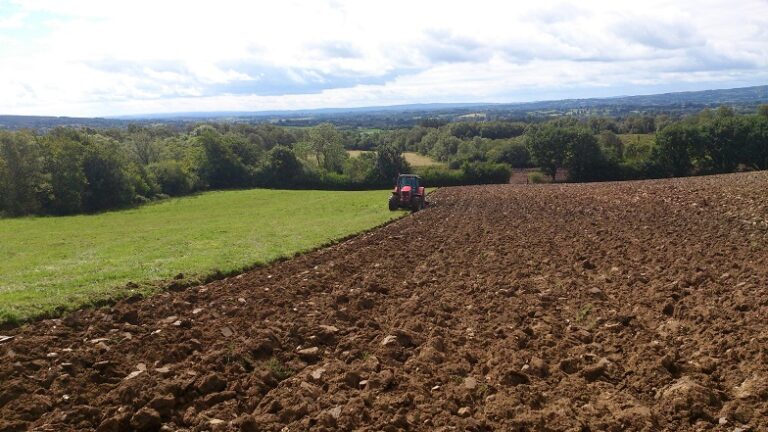
In early March 2026, farmers in the Northern Ireland Farm Network of the UK Dairy Carbon Network (UK-DCN) attended a webinar focusing on the role of incorporating high sugar grasses into their grassland to reduce greenhouse gas emissions, while maximising productivity. Speakers at the webinar included Mary McEvoy and David Little from Germinal, with the webinar facilitated by John Morrow, Agriculture Manager at AgriSearch.
Mary McEvoy (Technical Director at Germinal Ireland) opened the evening’s proceedings by providing an overview of the benefits of selecting high sugar grass varieties when carrying out reseeding. As grazed and conserved grass are a key part of UK dairy systems, grass quality has a direct influence on animal performance and emissions. Methane emissions from enteric fermentation and manure management make up around 76% of agricultural emissions, while nitrous oxide emissions make up around 19%. As Mary said, “There is a huge challenge for farmers to maintain productivity, while reducing emissions, and building resilience into their farm system to better cope with the shocks that are outside of the farmer’s control.”
High sugar grasses contain a high level of water soluble carbohydrates (WSC) that are an energy source for ruminants and rumen microbes. These carbohydrates are energy dense, meaning that high levels of WSC increase the dry matter digestibility (DMD) of grass, resulting in an increased amount of energy available to ruminants. The higher levels of WSC also aid the absorption of the highly soluble protein in grass forage through the increased provision of energy to rumen microbes, reducing the amount of waste nitrogen excreted in urine and dung.
Through the provision of high sugar grasses into grazing swards for dairy cows, there is the potential to increase grass dry matter (DM) intake by up to 1kg DM/head/day, helping to reduce reliance on purchased concentrates, with some studies showing production benefits of over 2 litres/cow/day. Reducing purchased concentrate usage while maximising milk yield has the potential to significantly reduce emissions intensity per litre of milk.
David Little (Agricultural Product Manager at Germinal) spoke on the importance of reseeding grassland and the practical considerations when deciding to reseed. Grass swards naturally decline over time, with older leys typically having lower digestibility, reduced energy content and poorer utilisation due to an increased presence of weeds. This was highlighted by the fact that perennial ryegrasses can reach 77-78 DMD, compared to weed grasses such as creeping bent with a DMD of approximately 58, meaning there can be up to 20% more undigestible fibre in weed grasses.
Typically, new reseeds can produce up to 16t DM/ha in the first 2-3 years of production, but this can deteriorate to 10t DM/ha or less within 7 years. To keep grass swards productive, it is important to consider reseeding fields every 10 years, where possible.
Reseeding also offers the opportunity to address weed and compaction issues, as well as improving response to nitrogen fertiliser by up to 25%, which significantly reduces the nitrous oxide emissions related to forage production from reseeded grass swards.
When planning reseeding, the first and most important step is to carry out soil sampling the winter prior to reseed establishment to assess soil pH and nutrient requirements. As David said, “This is the starting point before looking at doing any reseeding. Soil testing should be carried out every 2-4 years.” Targeting a soil pH of 6.2-6.5 and P+K indices of 2 are critical to maximising the value of a reseed.
When seeding, it is important not to establish grass seed too deep (1-2cm is optimal) and should be rolled afterwards to improve seed to soil contact, prevent excess moisture loss and help to break up any remaining clods. To maximise the presence of sown species in the reseeded sward, it is important to use a post emergence herbicide spray to kill any weed species present.
To conclude the webinar, John Morrow facilitated a question and answer session with the farmers, covering topics such as practical reseeding considerations and the role of red and white clover in grass swards. The webinar was well received by participating farmers, who look forward to further events on a range of practical topics in the coming months.