
Good silage clamp management is essential for reducing nutrient losses, preserving forage quality, and improving feed efficiency. All in all, this can help lower the carbon footprint of milk production by making better use of home-grown forage.
Successful ensiling depends on creating an anaerobic environment for fermentation but once clamps are opened, air exposure introduces oxygen and allows spoilage microbes to break down nutrients, generating heat in the process.
Aerobic spoilage not only reduces feed value and makes the business less efficient but it also increases mycotoxin risk, even where spoilage is not immediately visible.
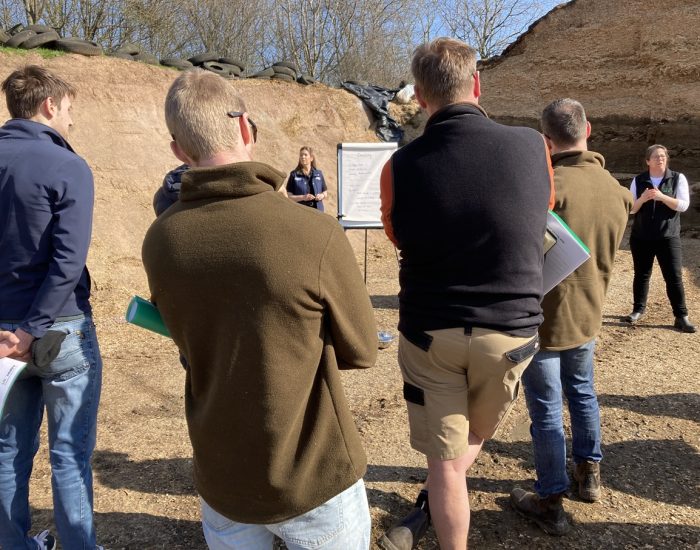
Speaking at a recent UK Dairy Carbon Network (UK-DCN) farm event in Cheshire, Kate Le Cocq, a silage microbiology scientist at Harper Adams University, explained how implementing simple monitoring practices can improve forage value, utilisation and overall efficiency.
Temperature monitoring
Temperature monitoring is one of the most practical ways to assess spoilage but the focus should be on temperature differences within the clamp, rather than as absolute figures.
Using temperature probes inserted at 10cm and 50cm depths across the clamp face, Kate demonstrated that, where spoilage is absent, the front of the clamp face should be cooler.
“This isn’t about having a target temperature for the clamp,” she added. “It’s about the difference between the shallower and deeper depths.”
As a rule of thumb, a greater temperature at the shallower (10cm) depth compared to the deeper depth indicates a problem. Kate stressed that surface temperatures alone are misleading, as sunlight can superficially heat the clamp face.
Density and compaction
Good compaction reduces air pockets, limits oxygen penetration and lowers the risk of spoilage and poor fermentation.
Density cannot be altered once the clamp is filled but Kate emphasised that measuring it provides valuable information for improving future ensiling practices.
To assess density, farmers need a silage corer (a drill-mounted corer to reduce time and effort); a tape measure; a small set of scales; and a calculator. Kate explained that a grid of nine core samples needs to be taken from across the face of the clamp for best representation of densities throughout the clamp.
She instructed to first work out the corer radius² by multiplying the radius by itself – for example, 0.025 × 0.025 = 0.000625. Then weigh the fresh sample (kg) and measure core depth (m). Calculate core volume using: π x radius² x depth. Finally, divide sample weight by core volume to calculate density as kg fresh matter (FM) per cubic metre (kg FM/m³).
“Densities upwards of 750kg FM/m³ are considered good,” said Kate. “But if you’re seeing numbers below 500kg FM/m³, that indicates poor compaction and high risk of spoilage and losses.”
The top and shoulders of clamps are often most vulnerable to spoilage due to easy oxygen ingress at these weaker points. However, Kate highlighted that clamp design can also influence density, with the host farm recording higher density against its sloped earth banks than in the centre of the clamp.
Fermentation and dry matter
Good fermentation relies on rapid production of acids, particularly lactic acid, which lowers pH and stabilises the forage in the clamp.
“A fast pH drop in the first few days is desirable,” said Kate. “It suppresses microbes that cause energy and nutrient losses, preserving those nutrients for feed out, if well managed.”
Simple on-farm pH testing can provide useful feedback on fermentation quality. To measure pH, mix 10g of a freshly collected sample thoroughly with 90ml of tap water for two minutes, then use litmus paper to determine the pH level.
Well-fermented grass silage sits around pH 4. However, pH varies depending on forage type, dry matter (DM) and the ensiling conditions. For example, low DM forages produce more total acid over a longer fermentation but dilution from the forage’s water content can make achieving low pH much more challenging.
On-farm, a practical squeeze-test can be used to estimate DM. Very wet silage releases a lot of liquid when squeezed, while drier silage becomes progressively springier and harder to form into a ball.
Pre-harvest, ensiling, and feeding out
Pre-harvest management plays a key role in silage outcomes.
For grass silage, Kate recommended targeting a wilted DM of 28-32% to support rapid fermentation and good preservation. “There are some things farmers can do to help them achieve this,” she said.
When done safely, a microwave test for DM estimates how much water has been removed from freshly cut grass during wilting. A small sample is weighed, dried carefully in a microwave, then weighed again to calculate its DM content, helping farmers judge when the crop has reached the target DM for ensiling. In some situations, diverting drier fields into round bales for dry cows, for example, may provide a better outcome than clamping unsuitable material.
Clamp sealing is also a critical control point. Kate strongly recommended using side sheets that fully extend to the floor and overlap with the top sheet. She also recommended temporary top sheets when filling over several days, and tightly placed gravel bags around all the edges at final seal, with evenly distributed top weight.
During feed out, Kate advised cutting top sheets back regularly to avoid allowing excess exposure of silage to air, as well as taking shallower blocks from the clamp face to increase feed out speed and reduce spoilage risk.
“Managing compaction, sealing and feed out speed remains the best defence against both visible and invisible losses,” she said. “We also encourage producers to use free resources like the AHDB Forage for Knowledge guide, to help assess current practices and identify areas for improvement.”
By monitoring temperature, density, pH and DM, farmers can identify opportunities to reduce losses and improve forage utilisation. These simple checks provide valuable feedback on silage-making and feeding out, helping to improve feed efficiency, support herd performance and maximise the value of home-grown forage. Sharing practical, evidence-based approaches like these is a key part of the UK-DCN, helping farmers reduce greenhouse gas emissions and improve business performance.