
Farmers taking part in the UK Dairy Carbon Network (UK-DCN) are continuing to adopt new practices to improve efficiency, productivity and environmental performance on dairy farms.
A growing focus of the project is ‘stacking’ – using several greenhouse gas (GHG) reduction measures together. While many projects look at single interventions, UK-DCN is exploring how combining multiple actions can deliver greater whole-farm benefits than implementing individual measures in isolation.
More than 160 actions are now being implemented by participating farms across Great Britain and Northern Ireland with 29 farms introducing a third or fourth option. The findings will provide valuable insight into how different combinations perform under commercial farming conditions and the benefits they can deliver across the whole farm business.
The measures cover a wide range of areas, including feed and nutrition, animal health, breeding, nutrient management, grazing management and manure handling. This reflects the fact that there is no single solution to reducing GHG emissions on dairy farms. Instead, improvements are often achieved through a combination of changes that work together to increase efficiency.
Livestock nutrition remains one of the most popular areas for action. Farmers are working with their nutritionists to optimise rations and make better use of home-grown forage. Some are also using feed products that contain ingredients such as supplementary fats, which may help reduce emissions per litre of milk produced.
Alongside nutrition, many farmers are focusing on fertility, mastitis control, youngstock health, genetics and nutrient management planning. These measures can improve performance and reduce animal losses. Healthier and more productive animals make better use of feed and resources, helping to improve both environmental and financial performance.
Jessica Graham, UK-DCN Farm Liaison Officer for the North Farm Network, has seen increasing interest in combining different GHG reduction methods:
“Within the region there are several farms currently exploring multiple greenhouse gas reduction measures together. One example would be from a participant farm that is currently updating their colostrum management protocol, which will boost their lifetime performance and lower greenhouse gas emissions per litre of milk produced. We have since carried out blood tests to assess antibody levels and the success of passive transfer, with total protein results close to target values, indicating good colostrum management this year.
“In addition to this, there are plans in place to incorporate sustainable parasite control to reduce anthelmintic resistance. This will involve antibody testing to pinpoint the timing of the first lungworm dose and carry out faecal worm egg counts for targeted treatment(s).
“There has also been a focus on infrastructure changes related to the subdivision of fields, water, roadways and pasture quality. Despite differences in feeding and farm systems across the Farm Networks, there are a broad range of actions that can be implemented and often more than one will be suitable.’’
Early examples of stacking are already providing valuable insights. Some farms are combining nutritional improvements with breeding strategies. Others are linking nutrient management planning with forage production and animal performance. The project hopes to understand whether these combinations can deliver greater benefits than individual measures alone.
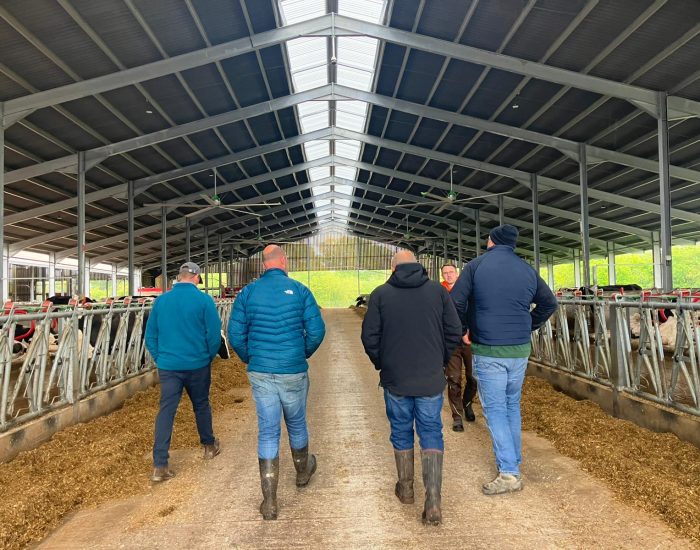
Knowledge exchange is playing an important role in supporting this work. Through open farm meetings, webinars and technical workshops, farmers are sharing experiences and learning from researchers and industry specialists. These activities help participants identify practical opportunities that fit their own systems and business goals.
As the project develops, the UK-DCN is showing that reducing emissions is not about finding a single solution. Instead, progress is likely to come from a range of complementary actions working together. By helping farmers adopt and assess multiple measures, the project is building a stronger evidence base for approaches that can improve both environmental and economic performance on dairy farms.