
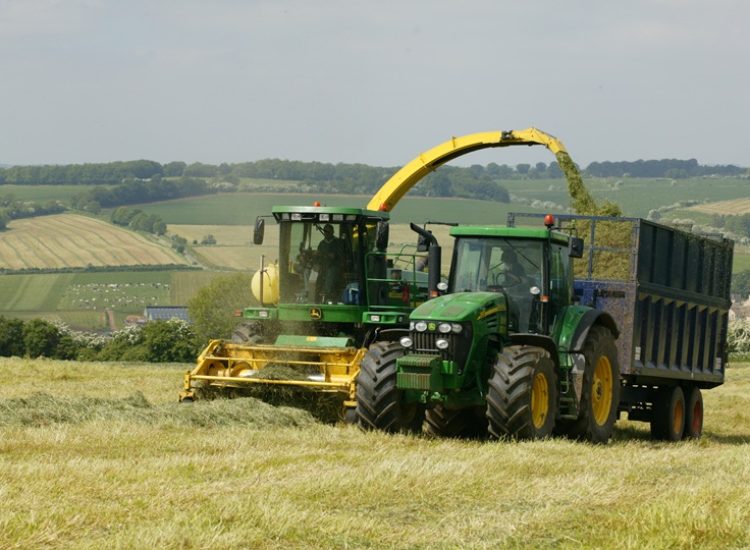
Rethinking cutting dates and silage quality has helped Edward Lister at Sibbersfield Lane Farm cut concentrate use from 0.4kg to 0.3kg per litre of milk. This shift has improved forage quality and feed efficiency, reducing costs and carbon footprint.
Farming with his parents, Chris and Selene, the 445-cow Cheshire enterprise focuses on efficient, profitable milk production – from calf to calving.
With their milk buyer placing a strong emphasis on carbon footprint, the business joined the UK Dairy Carbon Network (UK-DCN) to implement improved forage and feeding strategies. Hosting a UK-DCN practical on-farm event, they welcomed farmers from across the region and shared their approach to forage production.
Andrew Holland, Nutritionist to the farm and Director of Ontrak Nutrition, was joined by Dr Dave Davies, Forage Consultant at Silage Solutions, for a workshop to explain how cutting date, fermentable fibre and thinking differently influence forage quality and ration performance.
“Producing and feeding higher quality silage is crucial to improving cow performance and health,” said Andrew. “It also reduces reliance on purchased feed, utilises homegrown feed and land more efficiently, all reducing the farm’s carbon footprint.
“Rethinking cutting dates and understanding what really makes for a good silage are central to achieving this.”
Earlier is better
Cutting date remains the biggest driver of silage quality, although producers can be reluctant to cut earlier for fear of losing yield.
However, where crops are managed for good dry matter (DM) production, delaying harvest to bulk yields is unnecessary. Research shows annual DM yields are greater across multi-cut systems, with earlier, more frequent cuts increasing energy and protein yield.
Early cut, leafy grass, before stem formation and heading, provides highly digestible fibre that supports good feed intakes and rumen function. “Forget the calendar date,” said Dr Davies. “Cut at the right growth stage.”
Nutritional quality is largely driven by digestibility (D-value), which drops by around 0.5 units/day once stem formation begins. First cut timing also affects subsequent cuts, with 30–35 day intervals helping to produce more consistent quality silage in the clamp and at the feed barrier.
Effective fibre
An earlier multi-cut system delivers high-quality fibre when the focus shifts from total neutral detergent fibre (NDF) to fibre fermentability.
“Aim for a NDF below 44, ideally down to 42,” recommended Dr Davies, referring to NDF targets for highly digestible grass silage.
Low NDF silage is often viewed as ‘too good’ and requiring additional fibre, like straw, to support rumen health and function. Dr Davies and Mr Holland explained that diets can still maintain rumen pH because the total forage intake is increased and it is the forage that holds the effective fibre.
“By increasing forage intake – by feeding highly degradable silage – cows continue to ruminate effectively and cudding maintains saliva production, containing the bicarbonate which naturally buffers the rumen,” he added.
Lactic vs. acetic fermentation
As soon as grass is cut, sugars are respired and proteins start to break down, which is accelerated by harvesting. Therefore, getting preservation right is crucial for feed value and intakes.
Dr Davies explained that rapid fermentation – dominated by lactic acid – in the first 24 hours is essential. This quickly reduces pH which limits degradation and preserves more of the forage’s energy and protein.
In contrast, slower fermentation leads to more acetic acid, which is a weaker acid and has a lower energy yield compared to lactic acid, resulting in DM losses as CO2 and water through inefficient sugar fermentation. This inefficient process reduces D-value and overall forage quality.
In the field
Ensiling practices have a direct impact on the quality of forage entering the clamp.
For clamped silage, target 28–32% DM, mow in dry conditions – ideally in the morning if ensiling the same day – and aim to reach 30% DM within 12–24 hours.
Using a conditioner can speed wilting, while spreading crops wide and tedding within one to two hours maximises speed of drying. Row up just before pick-up, adjust chop length to suit DM for good consolidation, and aim to ensile within 24 hours.
“If you can, fields with lower yields or those facing the sun should be cut last and picked up first, this will help you get a more consistent going into the clamp,” added Dr Davies.
He also warned of contamination risks. High ash levels – often around 10% – impair fermentation and typically arise from soil or slurry residues. “Apply slurry within 24-72 hours using low-contamination methods like a trailing shoe. Splash plates increase risk.”
Results
For Mr Lister, the benefits of making changes are evident in improved forage quality and a significant reduction in concentrate use, without compromising output.
Recent analysis shows grass silage at 17.3% DM, 38% NDF and 74% D-value. It is fed as part of a total mixed ration (TMR), alongside grazing from March to October, supporting annual yields of 10,200 litres per cow at 4.48% butterfat and 3.48% protein.
On the advice of Mr Holland, the farm has moved away from fixed cutting dates, which were previously 5-6 May, and now takes first cut from grass in late April – cutting a much leafier crop.
“That has made a massive difference,” he said. “We struggled with second cut, it would always run to head no matter what we did, it had really high NDF and was very poor quality. Bringing first cut forward a week has made a big difference to subsequent cuts.”
Improved forage quality has reduced reliance on concentrates and lowered feed costs significantly. “Concentrate use has dropped from around 0.4kg to 0.3kg/litre of milk produced. And milking cow feed cost is now below 9p/litre,” said Mr Lister.
And despite infrastructure limitations, like operating with a single silage pit, the business has continued to make progress by working with what is available.
“Sometimes you get an excuse in your head – I can’t do this because I haven’t got the right facilities. But you can do enough to make a difference with as little as possible.”
Originally published in the July 2026 edition of Dairy Farmer magazine