
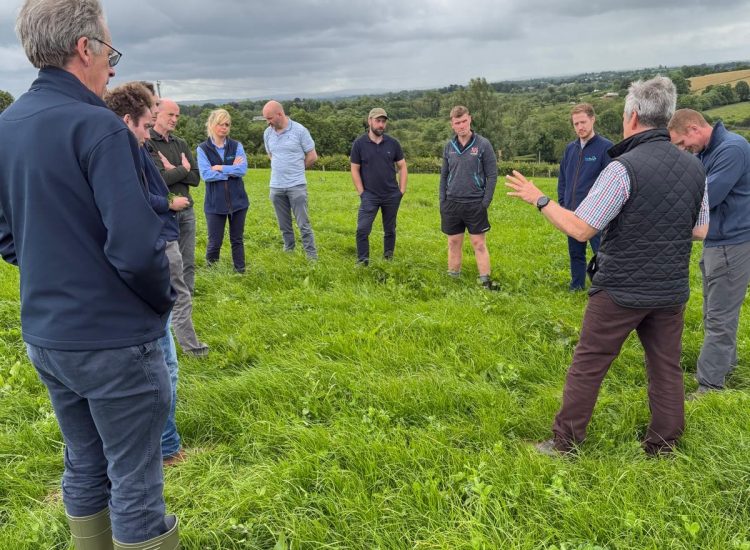
Farmers from the Northern Ireland Farm Network of the UK Dairy Carbon Network (UK-DCN) met in Moy, County Tyrone on the 17th June 2026 to find out more about the role red clover could play in forage production systems.
The meeting was held on a farm participating in the AgriSearch-funded ZeroNsile project, which is assessing the feasibility of incorporating Perennial Ryegrass – Red Clover silage swards into dairy, beef and sheep systems without using chemical nitrogen. Farmers heard practical management insights from the host farmer, supported with agronomy input from Dr David Patterson, AFBI Grassland Agronomist.
Red clover has the ability to fix atmospheric nitrogen, reducing the need for manufactured nitrogen fertiliser. This can help lower greenhouse gas emissions associated with fertiliser manufacture and application, while also supporting the production of high-quality homegrown forage.
A key part of the discussion focused on selecting appropriate varieties and seed mixtures. Dr Patterson recommended mixes containing 4kg red clover seed, 4kg of diploid perennial ryegrass and 4kg of tetraploid perennial ryegrass, along with 1kg white clover per acre. He also advised that red clover mixtures should be sown into a firm, fine seedbed at a depth of no more than 5mm to give the best chance of successful establishment.
Weed management was a keen area of debate, with farmers discussing the limited range of clover-safe herbicide options on the market. The conversation also looked at how weed sensors and artificial intelligence are being used in the development of tractor mounted spot sprayers, which could become an important key weed control tool for clover rich silage and grazing swards.
Nutrient management was covered by John Morrow, AgriSearch Agriculture Manager, who highlighted the importance of meeting potash and sulfur requirements of red clover to maximise yield. He encouraged farmers to apply little to no chemical nitrogen to red clover swards, as excess nitrogen can allow perennial ryegrass to outcompete the red clover and reduce nitrogen fixation.
John also shared findings from the ZeroNsile project, which show that the first cut is often the lightest cut in red clover swards, with the third or fourth cut often the heaviest. This is the opposite of what is typically seen in perennial ryegrass swards, and farmers were encouraged to resist applying nitrogen fertiliser to boost early season yields.
The practical challenges of harvesting and ensiling red clover were also covered. The host farmer explained that he had moved from pit silage to bales due to the lower dry matter of red clover compared to perennial ryegrass, and he now aims for a 48 hour wilt before baling.
Dr Patterson reminded farmers to raise the cutting height of mowers, avoid using conditioner mowers to prevent red clover crown damage and leaf shatter, limit over-tedding and rake the wilted crop gently.
The meeting concluded with a discussion on how to manage red clover swards as they begin to decline. Dr Patterson recommended that as the red clover dies out from year four onwards, they should begin to manage them as a perennial ryegrass-white clover sward. Introducing a natural rotational break can reduce the risk of clover rot, which can be a problem where red clover is established continuously without a rotation break.
By improving nitrogen use efficiency and reducing reliance on manufactured fertiliser, well-managed red clover swards have the potential to contribute to lower greenhouse gas emissions while supporting productive dairy systems.