
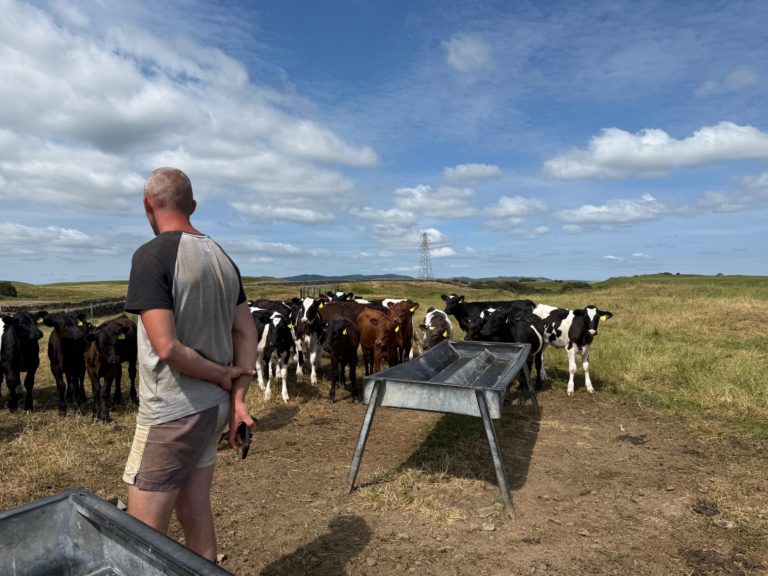
As Langbarns Farm in Dumfries and Galloway works towards organic status, regular calf weighing, colostrum monitoring and targeted health checks are helping identify practical ways to improve youngstock performance, boost lifetime productivity and reduce greenhouse gas emissions.
Working as part of the UK Dairy Carbon Network (UK-DCN), farmer Donald Armstrong is focusing on improving the measurement and management of youngstock to strengthen both herd performance and environmental efficiency. The rearing of replacement heifers is a key area influencing long-term productivity and emissions.
The 156-cow spring-calving herd, predominantly Irish Friesians and milked twice daily, produces an average of 5,000kg of milk per cow annually, with butterfat and protein levels of 4.5% and 3.5% respectively.
Replacement heifers represent a major investment in every dairy business, but Donald recognised there was an opportunity to better understand how calves and youngstock were performing throughout the rearing period. His focus has centred on calf growth rates, transition and weaning management, and identifying any factors that may be limiting animals from reaching their full potential.
Working alongside local vet Will McCarthy from Galloway Vets and UK-DCN Farm Liaison Officer Jessica Graham, the farm has introduced a programme of monitoring and targeted assessments to support more informed management decisions and improve long-term herd performance.
Introducing regular calf growth monitoring
Although Donald had routinely weighed bulling heifers, younger calves had not previously been monitored in the same way. Through the UK-DCN, regular calf weighing has now been introduced to provide a clearer picture of performance during the crucial early months of life.
Initial weighing of spring-born calves in May 2026 recorded an average daily liveweight gain of 0.71kg/day. The results also highlighted that some later-born calves were achieving lower growth rates than earlier-born animals, providing an opportunity to investigate potential causes and monitor progress more closely throughout the season.
By collecting regular weights, Donald can now track whether calves are meeting growth targets and identify issues earlier, allowing management decisions to be based on evidence rather than visual assessment alone.
Donald Armstrong said: “The UK Dairy Carbon Network has given us the chance to collect more information on our youngstock. The weighing and health checks have given us a much clearer picture of how our calves are performing, helping us make better-informed decisions and keep improving.”
Strong colostrum management delivering encouraging results
Giving calves the best possible start has also been a key priority on the farm. Strong colostrum management helps reduce disease risk during the critical early weeks of life while supporting improved growth and lifetime productivity.
Following a review of procedures, blood sampling was carried out to assess the success of passive transfer by measuring total protein levels. Results were close to target values, indicating that calves had received adequate immunity from colostrum and that the farm’s colostrum management this year had been successful.
Using science to understand growth challenges
Alongside weight monitoring, the farm worked with Galloway Vets to investigate whether underlying health issues were affecting calf performance.
Blood testing for trace elements found copper and selenium levels to be within normal ranges, indicating mineral deficiencies were unlikely to be limiting growth. There was also no evidence of exposure to Salmonella, Leptospira hardjo, Mycoplasma bovis or Histophilus somni among the animals sampled.
However, disease screening did identify evidence of exposure to parainfluenza-3 virus (PI3), while respiratory analysis also highlighted challenges from PI3 and Mannheimia haemolytica within the calf group. These findings have informed discussions around future calf health planning and vaccination strategies.
Rather than relying on assumptions, the health review programme has enabled Donald and his advisers to make management decisions based on farm-specific evidence.
Improving productivity and reducing emissions
Heifers that grow efficiently are more likely to reach breeding targets on time and enter the milking herd at the desired age. Earlier age at first calving and improved lifetime productivity help spread the emissions associated with rearing replacement animals across more litres of milk produced, improving overall carbon efficiency.
The work underway at Langbarns Farm as part of the UK-DCN demonstrates how relatively straightforward interventions, such as regular weighing, improved monitoring and targeted health reviews, can help farmers identify opportunities for improvement while supporting both business performance and environmental outcomes.