
Reducing methane emissions is one of the most effective ways agriculture can contribute to lowering greenhouse gas (GHG) emissions, while also improving farm efficiency and profitability.
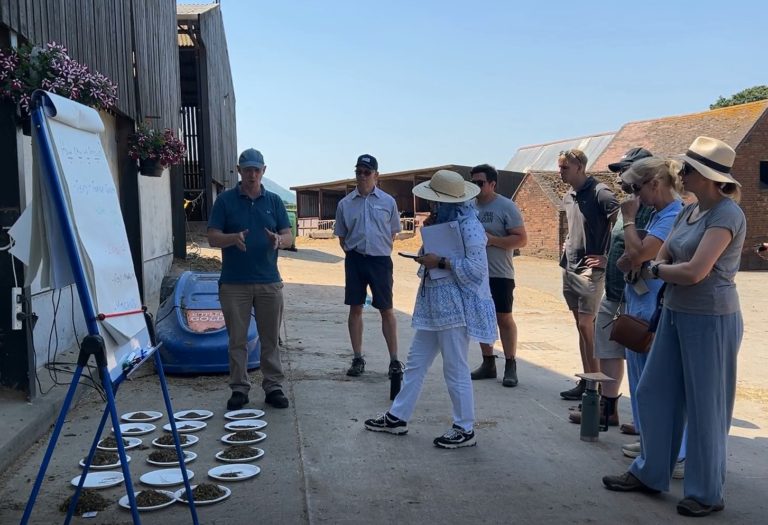
Speaking at the joint UK Dairy Carbon Network (UK-DCN) and AHDB Environmental Baselining Pilot Project Roadshow in Shropshire on 24 June 2026, Liam Sinclair, Professor of Animal Science at Harper Adams University, explored the practical steps dairy farmers can take to reduce methane emissions through improved feed and herd management.
“Around 50% of the UK’s methane emissions come from agriculture, with a significant proportion coming from cattle,” said Liam. “It is a highly potent greenhouse gas and is one of the key focuses in reducing agricultural emissions.”
Methane is a natural by-product of the ruminant’s digestive system, which has evolved to convert grass and other fibrous feeds into high-quality milk and meat. Rumen microbes break down fibrous feed through a process of fermentation, releasing hydrogen which is then converted into methane by specialised microorganisms known as archaea.
Liam stressed that while methane production is a natural biological process, it contributes significantly to a farm’s carbon footprint and represents a costly inefficiency, with some 8% of a cow’s gross energy intake lost as methane instead of being directed into production.
“To put that into context, about 8% of her feed is being wasted,” he said. “The methane produced by five cows contains enough energy to be able to heat an average UK home, while a 200-cow herd could heat around 50 homes over the winter.”
Improving feed efficiency
Nutrition and feed management present one of the biggest opportunities to reduce methane emissions. “Improving your forage quality and your grazing management can give you a 5-10% reduction in your methane output.”
Feeding out also presents a considerable opportunity for improvement. “In a UK study, which we did with AHDB, we found that 66% of farms had significant feed sorting by cows, 58% of farms had poorly mixed rations, and 34% of farms had no feed refusals,” said Liam.
He stressed the importance of evenly mixed rations and feeding to the point of having some refusals, to ensure a consistent ration remains available for long enough for all animals to meet their feed and nutritional requirements. This includes the less dominant stock, like heifers joining the herd and lame cows, all of which can struggle to compete at the feed barrier.
Liam added that refusals do need to be carefully managed, as excessive waste can indicate poor feed quality, as well as quickly increase a farm’s feed costs.
Adjusting the amount of starch, oils and fats in the ration can also help cows produce more milk per unit of methane, and in some cases help reduce methane production. However, Liam said that it must be done carefully with nutritional advice, as getting the balance wrong could negatively impact butterfat and, importantly, rumen function.
Methane-reducing technologies
The use of Methane Suppressing Feed Products (MSFPs) is another strategy, with the most effective able to reduce methane output by around 30% per cow.
Liam gave a balanced overview of currently available MSFPs and explained that their suitability depends on the production system and desired outcomes.
He explained that essential oils, for example, can be delivered in a slow-release bolus – which is useful for grazing herds – and can reduce methane emissions by 5-10%. Calcium nitrate, if fed as part of the ration, can reduce methane emissions by 15-20% and might suit higher input, housed systems.
The UK-DCN project currently has over 80 nutrition initiatives underway across participating farms, with a number of them using MSFPs such as SilvAir, Lintec and Megalac as part of their nutritional strategy. All MSFPs being used are registered, proven safe and have their efficacy published in peer-reviewed papers. Liam said, “We’re not doing anything that hasn’t been used before.’’
Liam stressed that to ensure the correct amount of MSFP is given, professional advice must be sought from a registered nutritionist and the feed manufacturer before proceeding.
Measure to manage
Considering the correct particle size of total mixed rations (TMR) to aid Dry Matter (DM) retention was also an area of focus in the session.
Liam asked the audience to identify the Penn State Separators out on display, which are used to assess the particle size and consistency of forage and TMR. The separator boxes are designed to be stacked on top of each other in descending order of sieve hole size, which are 19mm, 8mm and 4mm. Once the forage/ TMR is placed in the top box, the boxes need to be shaken and rotated several times before weighing the remaining material on each layer.
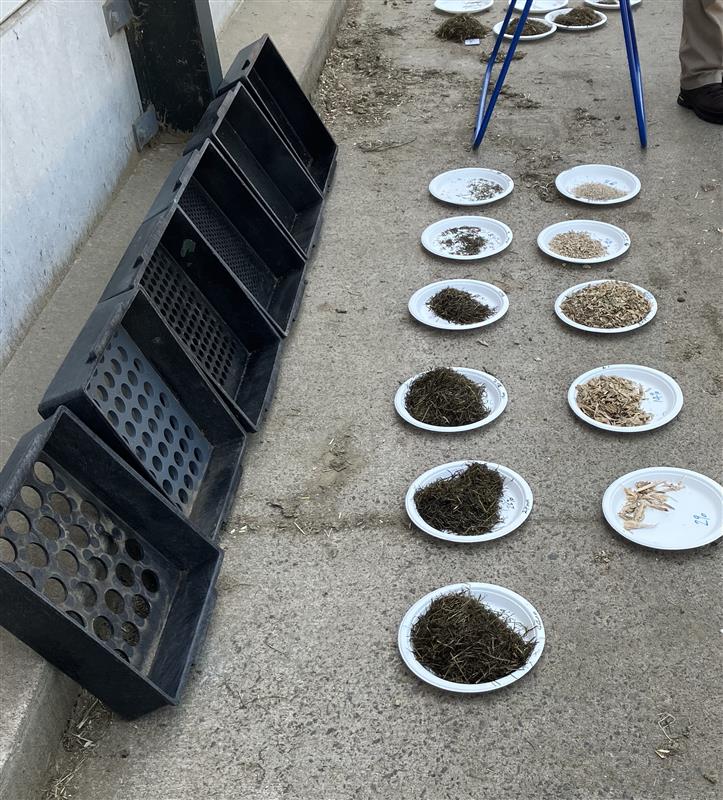
Measuring TMR particle size and ensuring consistency in the mix means it is more likely DM content will remain in the optimal range of 45-55%. The target range in regard to particle length is 6-18mm to support healthy rumen function.
The UK-DCN is also using advanced technologies to measure and benchmark GHG emissions, with the installation of GreenFeed systems on a small number of UK-DCN farms. “Methane can be very difficult to measure on a commercial farm – but we’re doing it,” said Liam, who has been involved with the implementation and data collection from GreenFeed units situated in the Midlands Farm Network.
The GreenFeed – or ‘sniffer’ system – is a specialised piece of equipment temporarily installed on farm that measures gases exhaled by cows, including methane and carbon dioxide. It provides a benchmark of emissions under commercial conditions.
Once benchmarked, this information can be used in combination with wider farm data to assess the impact of GHG reduction strategies in place, or to aid the implementation of additional strategies to lower emissions whilst supporting farm productivity and profitability. This is at the heart of the UK-DCN project – using on-farm data and practical measures to demonstrate how dairy farms can reduce emissions while maintaining productivity.