
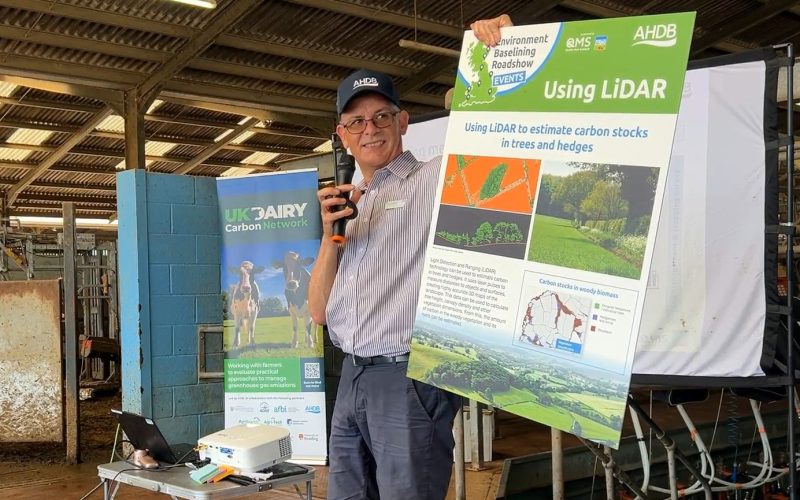
Helping dairy farmers make informed decisions that benefit both their businesses and the environment was the focus of a joint UK Dairy Carbon Network (UK-DCN) and Environmental Baselining Pilot event held at Bentley Ford Farm in Shropshire on 24 June 2026.
Hosted by UK-DCN farmers David, Cheryl and Rob Higgins, the event combined practical on-farm experience with the latest AHDB-led environmental baselining research, demonstrating how robust data can identify opportunities to reduce greenhouse gas (GHG) emissions and improve the dairy business.
Milking just over 200 pedigree Holsteins supplying Müller, the Higgins family joined the UK-DCN to gain a clearer understanding of their farm’s carbon footprint and identify practical opportunities for improvement.
“There is a lot of focus on carbon from milk buyers, but it can sometimes feel like quite a woolly subject because it’s based on a lot of assumptions,” explained Rob.
“We want to dive deeper to understand what our carbon footprint really looks like. Establishing a baseline means we’ve been able to target areas for improvement and, going forward, we’ll have a clearer picture of the outcomes.”
That ambition reflects the UK-DCN’s aim of helping farmers identify, implement and assess practical, farm-ready solutions that reduce emissions and improve efficiency and productivity.
Environmental baselining
Chris Gooderham, environment director at AHDB, shared the first findings from the Environmental Baselining Pilot, an AHDB-led initiative – supported by Quality Meat Scotland (QMS) and Hybu Cig Cymru (HCC) – involving 178 farms producing dairy, beef, lamb, pork, cereals and oilseeds across a wide range of soil types and landscapes throughout the UK.
“When we’re talking about net zero, we need to talk about the ‘net’ bit,” he said. “It’s not just emissions, it’s also sequestration – and then put that alongside biodiversity, flood prevention and air quality.”
The pilot measured carbon stored in soils, hedgerows and trees through comprehensive soil sampling to 1m depth, LiDAR (Light Detection and Ranging) scanning – which uses pulsed laser light to measure distances and create precise three-dimensional maps of vegetation and tree structure – and carbon auditing.
Early findings showed that 95% of carbon stored on participating farms is held within the soil, with measurements limited to the top 30cm, as is common practice, potentially underestimating total soil carbon stocks by around 30%, with almost one-third of soil carbon found below that depth.
Chris said understanding where carbon is stored is essential, not only to identify opportunities for sequestration, but also to protect existing stores.
“We want farmers to remove carbon from the atmosphere, but it’s just as important that we don’t release the carbon we’re already storing.”
The project will continue to explore how soils, land use and management influence carbon storage, helping strengthen future carbon reporting and support better on-farm decision-making.
Reducing methane
Liam Sinclair, Professor of Animal Science at Harper Adams University, who works on the UK-DCN project, discussed how improvements in nutrition and feed management can improve feed efficiency while reducing methane emissions.
“Methane is about 8% of the cow’s gross energy intake,” he said. “So, about 8% of the feed is being wasted – we really don’t want to be losing that energy.”
Liam explained that many methane reduction strategies are already recognised as good farming practice. This includes improving forage quality, balancing rations accurately and feeding out effectively to reduce sorting and competition at the feed barrier.
“Improving your forage quality, which includes grazing management, could give you a 5-10% reduction in methane output.”
Using Penn State Separators, a simple tool to assess the particle size distribution of forage and total mixed ration (TMR), he demonstrated how farmers can assess ration consistency and identify poor mixing or feed sorting.
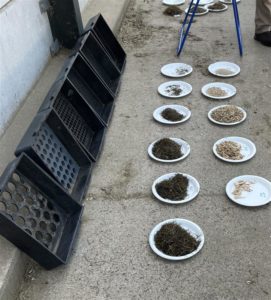
“It’s a simple and easy management tool on farm,” he said. “There’s what you formulate, what goes into the mixer wagon, what comes out of the mixer wagon, and then there’s what the cow eats.”
Liam also challenged refusals. “No farmer likes to see feed being thrown away, but if you don’t have a certain percentage of refusals, you’re probably underfeeding your lowest social ranking animals – often the heifers, which are your future milking herd.”
The use of Methane Suppressing Feed Products (MSFPs) was also discussed, with the most effective able to reduce methane output by around 30% per cow.
“Within the UK-DCN several of these MSFPs are available to our commercial dairy farms so the project can measure their effect on methane production under practical farming conditions.”
Practical nutrient decisions
Practical nutrient management and soil organic matter (SOM) formed the focus of an in-field session with Frontier Agriculture’s agronomist Dai Morgan and sustainability technical lead Robert Nightingale.
Dai explained how detailed soil analysis, slurry testing and variability mapping allow farmers to target nutrient applications more accurately, make better use of slurry and reduce reliance on purchased fertiliser.
Using Bentley Ford Farm’s own data, he demonstrated how better information can support better decisions.
“By mapping soils and understanding the nutrient status across the farm, we can move away from blanket applications and make much more targeted applications of both slurry and purchased fertiliser,” he said.
Variability mapping revealed significant variation in phosphorus (P) and potassium (K) levels, with historic applications of magnesium limestone also continuing to influence soil pH and nutrient availability.
“How can you do slurry management if you don’t know where the variability is across the farm? There also needs to be an accurate picture of the nutrients already on farm,” he added.
Slurry analysis also showed lower P but higher K levels than standard industry figures, highlighting the value of regular testing over standard assumptions.
Combined with investment in an umbilical slurry system, the Higgins family has improved the timing and accuracy of slurry applications, completely removed synthetic P and K fertilisers from their grassland nutrient management plan and reduced soil damage by lightening the weight of travelling loads.
Building on the nutrient findings, Robert discussed the role of SOM in maintaining productive, resilient soils.
“Soil organic matter is fundamental to how soils function,” he explained. “It helps improve structure, supports water infiltration and increases the soil’s ability to capture and retain moisture. This is becoming increasingly important as we see more extreme weather patterns.”
Increasing SOM by 1% can provide around 75,000 litres of additional plant-available water per hectare, depending on soil type. However, Robert stressed that this alone is not enough for increasingly common waves of extended periods of drought.
Improving both infiltration and water-holding capacity helps soils capture more rainfall between increasingly common cycles of drought and deluge. “You get those two working together, you can see you can accumulate more rainfall through a season.”
By bringing together practical demonstrations, on-farm experience and the latest research, the event reflected the UK-DCN’s aim of helping dairy farmers adopt evidence-based approaches that improve both environmental and business performance.