
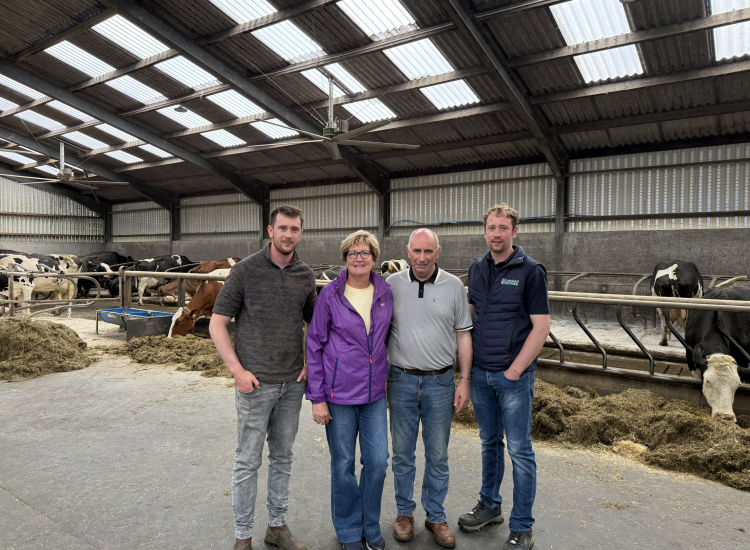
Already focused on improving milk production efficiently, Ciaran McNaughton is working with the UK Dairy Carbon Network (UK-DCN) to fine-tune nutrition, breeding and nutrient management on his Co. Antrim dairy farm.
Outside Corkey, Co. Antrim, Ciaran farms alongside his brother Brian and parents Sean and Anne. The family milk 65 cows through a single Lely Astronaut A4 robot, with the year-round-calving, fully housed herd averaging 12,350kg of milk solids from 4.2 tonnes of concentrate feed annually.
Producing high levels of milk from good-quality forage has been a key focus for Ciaran. Average yield has risen from 32 litres per cow per day in 2023 to 41.6 litres in 2026, while the milking herd has grown from 52 to 65 cows.
Building on existing work
In the first year of the project, Ciaran chose breeding, enhanced nutrient management planning and diet reformulation as his main areas of focus. Rather than making wholesale changes to the system, Ciaran saw the project as an opportunity to build on work already underway and use additional data and advice to strengthen his approach.
Fine-tuning the diet
The project gave Ciaran an opportunity to review the cow’s diet to refine the feeding strategy and enhance cow performance. He said: “I was interested in diet reformulation to help increase production and optimise cow health. The logical next step for us to fine-tune the herd was to look at incorporating protected amino acids to help reduce dietary crude protein and the overall feed rate”.
Reducing dietary crude protein can lower nitrogen excretion in faeces and urine, reducing the level / extent of nitrogen loss and ammonia emissions.
The diet reformulation began with 40g of protected methionine, supplied through a mineral dispenser fitted to the Lely robot. Amino acid profiles of the forage and concentrates showed lysine to be the next limiting amino acid. Supplementation was then adjusted to 20g of protected methionine and 20g of protected lysine.
Ciaran has seen the clearest response among freshly calved cows. He observed a positive yield response in cows up to 100 days in milk, together with fewer metabolic issues after calving.
Using breeding data to guide decisions
The move towards a more Holstein-based herd away from crossbreds is being driven by Ciaran’s focus on milk components, but he is also looking beyond production when selecting the next generation.
Through the project’s breeding option, he has used his herd genetic report and advice from AHDB’s genetics team to identify strengths and areas for improvement, while refining his bull selection criteria to incorporate the AHDB EnviroCow index. Genomic evaluation of youngstock has provided more accurate information to support Ciaran’s breeding decisions. This gives him more confidence when deciding which heifers to retain, helping accelerate genetic progress within the milking herd.
Planning nutrient use
With four cuts of silage taken from the farm’s 105 acres, getting the most from available nutrients is central to Ciaran’s forage strategy.
Maintaining soil health is an important part of producing high-quality forage and growing high yields of grass. Previously, he created his own nutrient management plan for the silage and grazing areas. Through the project, an adviser prepared a plan that targets slurry and farmyard manure to fields with lower phosphorus and potassium indices. The approach minimises the purchased chemical fertiliser required to grow grass while maintaining and improving soil indices.
Ciaran has also introduced slurry separation, which has been carried out twice to date by a contractor using a mobile separator. This approach has enabled him to apply the liquid and solid fractions separately across grazing and silage areas, allowing nutrient applications to be better aligned with the farm’s phosphorus and potassium requirements while reducing the risk of slurry contamination of forage crops. On some farms there may also be opportunities to export the solid fraction to land with a greater nutrient demand, particularly for phosphorus, or to anaerobic digestion facilities for further processing helping reduce individual farm nutrient surpluses.
Looking ahead
Looking ahead, Ciaran plans to continue refining the feeding strategy, including amino acid supplementation and the use of additional feed additives to further enhance cow performance and efficiency.
“Hopefully, I will continue to see benefits for herd performance and reductions in emissions,” he says.
The breeding work will also continue, with genomic evaluation of the next generation of heifers providing another opportunity to assess whether the traits being selected for are delivering the progress Ciaran wants to see.
“Now that I am a year into the breeding option for reducing emissions, with more data available on the herd through genomic testing, I hope to use this data to make more informed breeding decisions.”
The UK-DCN has given Ciaran the opportunity to take a closer look at areas where further improvements could be made. With nutrition, breeding and nutrient management all contributing to the farm’s overall efficiency, he is now using the knowledge and data gained through the project to guide the next stage of development.
The UK Dairy Carbon Network is working with over 50 UK dairy farms to implement and assess practical, farm-ready solutions for reducing greenhouse gas (GHG) emissions. Led by AFBI and funded by DEFRA, the project is supported by a UK-wide consortium of leading research and industry partners.