
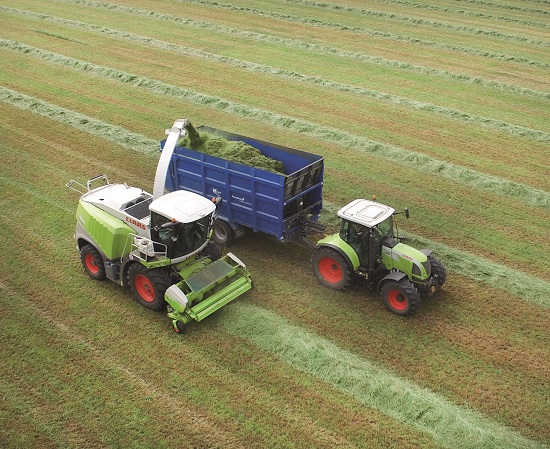
Nutrition and nutrient management are two important areas of focus for the UK Dairy Carbon Network (UK-DCN) project, with both having a significant impact on the efficiency and environmental performance of a dairy farm.
Forage quality is fundamental to both – from what is grown and ensiled to what is ultimately fed to the cow. Improving forage quality offers a practical opportunity to optimise cow health and performance while also reducing greenhouse gas (GHG) emissions.
During a recent UK-DCN webinar, James Husband, livestock consultant at Map of Ag and a qualified vet, highlighted why homegrown forages and protein matter for production, profitability and environmental performance.
High-quality forage
Feed intake is limited by rumen volume, so there are physical limits to total dry matter intake (DMI). The best way to increase efficiency and feed conversion is by having high-quality forage with good digestibility.
“Forage can account for more than 50% of a herd’s total dry matter intake (DMI), so it represents a significant part of the ration,” said James.
Improving fibre digestibility supports higher intakes and rumen throughput, benefiting rumen function and milk production. Whereas low-quality forage is harder to digest and spends longer in the rumen, suppressing DMI.
Neutral detergent fibre (NDF) is the structural component of forage and affects forage digestibility. NDF comprises three fibre types: hemicellulose, cellulose and lignin. Hemicellulose and cellulose are easily degradable in the rumen and are processed relatively quickly, allowing for a higher DMI intake. Lignin, however, takes much longer to break down.
Forage with a higher proportion of easily degradable fibres can achieve an optimal NDF digestibility of around 30 hours of rumen digestion time. However, bulkier forages that contain more lignin can remain in the rumen for as long as 240 hours.
James advised that, ideally, 65% of forage in the ration should have an NDF digestibility of 30 hours for optimal results, with values greater than 75% considered above average. A 1% increase in NDF digestibility can increase DMI by 0.17 kg and yield by 0.25 litres of 4% fat-corrected milk.
Fibre digestibility
Forage quality and digestibility are linked to cutting time, which is heavily influenced by weather conditions and crop maturity.
“A delay of one week beyond the optimum cutting time will drop the metabolisable energy (ME) value of the silage by 0.5-0.6MJ/kg – which is quite a big reduction,” James said.
For higher-yielding herds, concentrates are often needed to supplement forage. However, higher-quality forage can reduce the amount of concentrate required and help to lower feed costs. James explained that for a milk yield of 9,000 litres, reducing concentrate use from 0.36 kg/litre to 0.26 kg/litre could save around 3p/litre in feed costs, assuming a concentrate price of £300/t.
And, from an environmental perspective, concentrates also carry a greater emissions cost. “Forages produce around 80-150 kgCO₂ per tonne, whereas concentrates will always be at about 700 kgCO₂ per tonne,” James added.
Nitrogen and nutrient use efficiency
Producing high-quality forage requires effective nutrient management, particularly nitrogen, which can be supplied to the soil using bagged fertiliser or fixed from the atmosphere by legumes, such as clover when incorporated into grass leys.
This is where nutrient use efficiency becomes important. “If that whole process works very efficiently, the outputs that we can measure – the meat, the milk – will be maximised,” said James.
Improving nitrogen use efficiency can be achieved through a variety of methods. The inclusion of red and white clover fixes atmospheric nitrogen, reducing reliance on manufactured nitrogen fertiliser and boosting soil health.
Productive soils need aerobic conditions, so reducing compaction will improve nutrient cycling to the extent that quality and yield can be maintained with 20% less purchased nitrogen.
Reducing soil compaction can be achieved through improved field drainage and avoiding the use of heavy machinery on fields that have recently had heavy rainfall. Considering machine size and total axle loads can also reduce pressure on the soil.
James also recommended working alongside nutritionists and agronomists to optimise diets and establish nutrient management plans according to desired outcomes.
It is possible to maximise nitrogen use efficiency at every stage of the cycle. Encouraging nitrogen uptake through the use of cover crops or bagged fertiliser, while maintaining good soil health management practices, helps produce high-quality forage. This can then be efficiently digested in the rumen and converted into a key energy source to support milk production and animal performance.
Getting the balance right is crucial to maximise forage production while minimising environmental harm. Nitrogen can be lost to the atmosphere in warm conditions, while heavy rainfall, particularly after a prolonged dry period, can increase the risk of run-off into watercourses.
Excessive nitrogen can also pose a risk to animal health through nitrate poisoning, which can occur when plants take up nitrogen from the soil faster than they can convert it into proteins, allowing nitrates to accumulate in the plant. If forage containing high nitrate levels is consumed, it can interfere with the blood’s ability to carry oxygen, potentially causing serious illness or death.
Choosing the right forage for your farm
With nitrogen making up almost 80% of the earth’s atmosphere, James explained how nitrogen-fixing crops can capture ‘free’ nitrogen, helping to produce a higher-protein forage and reduce reliance on artificial fertiliser.
White clover can be included in a grazing seed mix or stitched into an established grass ley, while red clover is better suited to silage leys.
“Clover can produce a forage that is sitting at 16-17% crude protein by fixing nitrogen from the atmosphere,” said James. “Potentially there are quite big wins. If you get a 20-30% inclusion rate of white clover, the potential nitrogen supply is 180kg N/ha. If you get up to 50-60% it can be 300kg N/ha.”
There are, however, some practical considerations. While inorganic fertiliser can be cheaper as a one-off purchase, its price and availability are volatile. Clover tends to flourish later in the season, which can help maintain forage protein levels when straight grass leys may struggle. However, earlier cuts may not deliver the same benefit, and competition from weeds can be difficult to control because of the limited range of clover-safe herbicides.
Other options James noted were herbal lays and lucernes, but while effective, these are more demanding options which require even greater care over soil type, farming system, and management.
Forage management
The process of producing high-quality forage does not end once it has been cut. Ensuring efficient processes for clamped or ensiled silage reduces waste and maintains Dry Matter (DM) levels.
James suggested aiming for 10-12 t of DM per hectare, but warned that losses of up to 30% can occur if harvesting and ensiling are poorly managed.
For clamped silage, target 28-32% DM at cutting and, where needed, wilt rapidly to around 30% DM within 12-24 hours. Conditioners can speed wilting, while spreading the crop wide and tedding within one to two hours maximises drying. Row up shortly before collection, adjust chop length to DM for good consolidation, and aim to ensile within 24 hours.
To improve forage quality and crude protein content, many factors must be taken into consideration at every stage of the growing and feeding process.
From the timing of the first cut, to reducing wastage at the clamp, each small change helps improve the digestibility and quality of the forage, leading to increased DMI, which will support farm productivity and profitability.
The UK-DCN project is currently working with participant farmers to help put these changes into practice, delivering benefits to both the bottom line and the environment.