
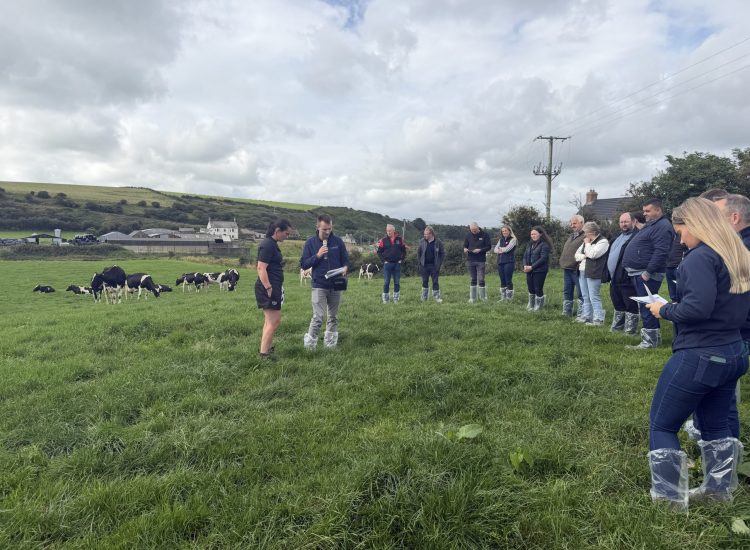
Breeding, grassland management and feeding decisions were among the practical areas explored at a recent event on September 3rd hosted by dairy farmer Caryn Webster at Browns Bay, County Antrim, as part of the UK Dairy Carbon Network (UK-DCN).
Caryn milks around 60 Holstein cows in a medium-input, grass-based system, with the herd averaging approximately 7,500 litres of milk per cow per year. Browns Bay is one of 20 Northern Ireland dairy farms involved in the UK-DCN and one of 56 participating farms across the United Kingdom. Led by the Agri-Food and Biosciences Institute (AFBI) and funded by the Department for Environment, Food and Rural Affairs (Defra), the project is driven by a UK-wide consortium of leading research institutions and industry organisations. The Northern Ireland UK-DCN Farm Network is managed by AgriSearch.
A major theme of the farm walk was the importance of breeding cows that suit the individual farm system. Caryn has been making greater use of genomic information when selecting replacement animals and breeding sires, alongside traits including fertility, maintenance, milk components and cow size.
The results from this on-going strategy are beginning to show in the younger animals. The milking herd currently ranks within the top 55% for the Profitable Lifetime Index (PLI), while the younger stock rank within the top 45%. A similar improvement can be seen for fertility, with the younger animals ranking more strongly than the current milking herd.
Discussion also covered how genomic information can provide farmers with greater confidence when making breeding decisions at an earlier stage, helping them select animals that are better suited to the long-term needs of their herd.
Grassland management was another important part of the discussion. Caryn has been measuring grass growth through the AgriSearch GrassCheck programme since 2023. Despite challenging weather conditions, the grazing platform produced 9.38 tonnes of dry matter per hectare during 2025 and had produced 7.73 tonnes per hectare by September 2026.
A further focus of the farm walk was on practical ways to make further improvements to grass utilisation, including changes to grazing infrastructure and the positioning of water troughs within paddocks.
Feeding decisions were also discussed. Changes to the winter ration at Browns Bay were followed by an increase in average milk yield from around 21.5 litres to 25 litres per cow per day over a ten-day period. Caryn is continuing to assess how feeding can best complement the grass-based system and the type of cow being bred for the farm.
Caryn Webster said:
“We are trying to breed a cow that fits our system and to make the best use of the information available to us. Fertility, maintenance, cow size and milk quality are all important, alongside how the cows perform from grass. Bringing all of that information together helps us make better breeding and management decisions.”
Sarah Harbison, UK-DCN Farm Network Manager at AgriSearch said:
“The value of UK-DCN is in bringing farmers together on commercial farms to discuss practical decisions and see how different parts of the system interact. Browns Bay provided an excellent example of that. Breeding, grassland management, feeding and infrastructure cannot really be considered in isolation if the aim is to develop a productive, efficient and resilient dairy system.”
“There was also a useful message about continual improvement. The objective is not necessarily to make major changes all at once, but to use good information to identify where improvements can be made and then track whether the farm is moving in the right direction.”
UK-DCN is focused on identifying practical approaches that can help dairy farms improve efficiency while lowering greenhouse gas emissions. The network enables farmers, researchers and industry specialists to share information and experience across a diverse range of commercial dairy systems.