
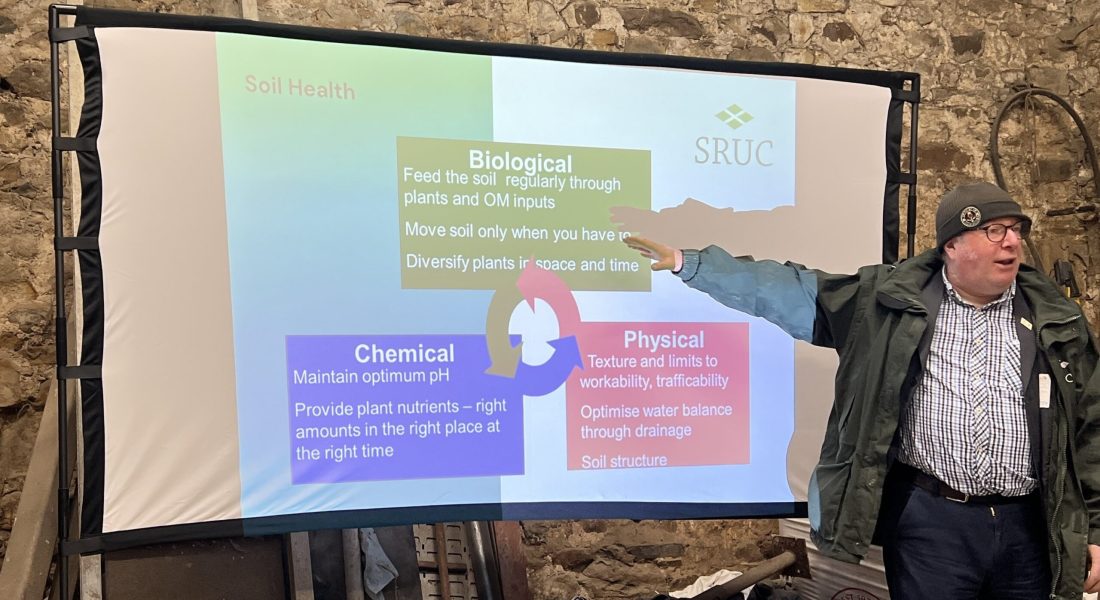
Healthy soils underpin productive grassland and efficient nutrient use. During a UK Dairy Carbon Network (UK-DCN) workshop on 26 February 2026, farmers explored how soil structure, organic matter and simple field assessments can improve performance while reducing greenhouse gas (GHG) emissions.
Paul Hargreaves, soil scientist and grassland researcher at the SRUC Dairy and Innovation Centre, led a practical session on the principles of soil health and the management practices that influence productivity and GHG emissions.
Soils consist of a complex mixture of minerals, water, air, organic matter and living organisms, including bacteria, fungi, roots, humus and earthworms. Understanding how these components respond to environmental and management pressures is essential for maintaining and improving soil health, Paul explained.
“In the past, we were most concerned about the chemical aspect of the soil, making sure there was enough nutrients for the crops. But increasingly we have been thinking more about the physical and biological aspects – all are pillars of healthy soils.”
Paul advised that identifying soil texture is a crucial first step and emphasised that this inherent property dictates many soil behaviours and management decisions. “Whatever soil texture you have got, you are stuck with that,” Paul added.
Sandy soils tend to have larger pore spaces and a higher risk of nutrient losses, through mechanisms such as nitrate leaching, compared to heavier soils. While texture cannot be changed, soil structure can be improved through management practices, for example, by routinely incorporating adequate organic matter. Good soil structure supports plant root development, water filtration, aeration and biological activity – all of which are vital for healthy plant growth.
Maintaining the optimal soil pH remains essential.
“Aim for a pH of around 6.5,” Paul advised. “If your pH drops, particularly below 5.5, you will be applying expensive fertiliser and slurry – which won’t be doing the work.”
Compaction
Compaction remains one of the biggest threats to soil structure.
“In wet conditions, 70% of the damage to soil structure can be done in the first pass of heavy machinery,” said Paul.
Heavy machinery can compact soils to depths of 10–25cm, while cattle poaching can reach 10–15cm. Even shallow surface capping can restrict water filtration and nutrient movement.
Research conducted over three years at SRUC’s Crichton Royal Farm in Dumfries and at Harper Adams University in Shropshire demonstrated the scale of the impact on grass production: tractor-induced compaction reduced grass yields by 14.3% in both clay and sandy soils, while livestock trampling caused yield losses of 11% and 12.2%, respectively.
Compaction can also increase input costs. One study showed that compacted fields required an additional 50kg of nitrogen/hectare to achieve similar grass yields to uncompacted soils.
Paul also drew attention to nitrous oxide emissions, which can be ten times more potent than methane.
“The wetter your soil, the more nitrous oxide will be produced, and that increases every time you apply nitrogen. But this problem can be alleviated by putting some structure back into the soil.”
Soil organic matter and worms
Soil organic matter (SOM) – effectively the carbon content of soils – plays a major role in soil stability, drainage and fertility.
“It also feeds soil microbes, encouraging biodiversity, which are all good things for soil health and productivity,” Paul added.
Frequent cultivation or damage, however, results in carbon (CO₂) losses. Although SOM can be rebuilt through management practices that minimise soil disturbance and maximise organic matter inputs, soils typically stabilise and reach a new equilibrium after around 20 years, unless management practices change again.
Earthworms also serve as useful indicators of soil health, Paul explained. Surveys frequently show large variations in earthworm numbers across a single farm, with sparse numbers in wet, compacted areas around cattle feeders, and higher populations in long-established leys and multi-species swards.
Measure, monitor, manage
Paul encouraged farmers to combine laboratory soil analysis with simple field observations.
“So much of this you can do using just touching and feeling the soil. Dig out a block of soil the depth and width of your spade and start pulling it apart. The soil will tell you a lot about its condition.”
Two soil blocks taken only metres apart during the workshop illustrated this clearly: one showed a crumbly structure with abundant roots and a healthy, earthy smell; the other was dense, had a sour odour and displayed orange mottling – signs of waterlogging and poor structure.
“These two blocks show how much variation can exist within a single field,” Paul remarked. “So, it’s important to take multiple samples across a field and focus on problem areas.”
Tools like the AHDB Visual Examination of Soil Structure (VESS) and its Soil Health Scorecard support farmers in confidently recording and benchmarking analysis data and observations. Both resources utilise a traffic-light system to help guide management decisions.
By combining practical field assessments with ongoing support from the UK-DCN’s Farm Liaison Officers, academics and experts, farmers can turn soil insights into action on their own farms. Through workshops like this, the project demonstrates how hands-on learning, shared experience and evidence-based management can help improve soil health, boost productivity, and reduce emissions across the wider dairy network.